Showing posts with label world. Show all posts

Tuesday, January 3, 2017

Chinese reconfiguration of economy and preparation for cultural export

Chinese programmes and media corporations have greatly filled their coffers these past few years with their tremendously popular song competition programmes which have seen influence in South Asia.

take a look at the scale of these programmes


and these are done on weekly basis.

So recently, there has been a bit of restrictions from the authorities, clamping down on the impressions that these shows will make on the youths.

去年7月,广电总局曾就发出了《关于加强真人秀节目管理的通知》,要求真人秀节目避免过度明星化,摒弃“靠明星博收视”的错误认识,不能把节目变成拼明星和炫富的场所,并提出真人秀节目应注意加强对未成年人的保护,尽量减少未成年人参与。

That's not all. Culture is one of the biggest export a country has. In fact, without cultural export, you can forget about Margin. This is also one of the reasons Japanese and Korean exports have reversed positions over the past 17 years.

Previously Japanese cultural export via their anime, manga, movies, songs has tremendous benefit and supports their exports of other products. In recent decades, they have been taken over by Korea. You can see this effect on your supermarket selves or cosmetic products.

China, it seems, realizes this:
http://baike.baidu.com/item/%E9%99%90%E9%9F%A9%E4%BB%A4

随着萨德系统的部署,传言中国政府限制韩国艺人和节目的举措全面开启,中国广电总局的禁令包含:禁止BigbangEXO等团体中国演出;停止新的韩国文化产业公司投资;停止韩国偶像团体面向1万名以上观众演出;禁止新签韩国电视剧、综艺节目合作项目;禁止韩国演员出演电视剧在电视台播放等多项规定的措施已经传达到各电视台,并要求在9月1日开始实施。
2016年11月,有韩国媒体不断炒作中国发布“限韩令”的消息。中国外交部发言人耿爽已在21日的例行记者会上表示,没有听说所谓的“限韩令”。[1] 2016年12月6日,上海市文化广播影视管理局日前批准韩国双人组合乐童音乐家在上海举办演唱会。这是自2016年10月以来中方首次批准韩国歌手在华举办演唱会


Saturday, August 20, 2016

Japanese government to force companies to pay higher wages


this higher minimum wage move is a dangerous policy. yet they are running out of alternatives.

ever easing monetary policy to give companies money to spend on investment and infrastructure has backfired onto reversing yen devaluation, almost back to 2011 values.
meanwhile, companies have stayed put.

and they have now to juggle both the effects of high debt, strong yen and cushioning both the JGBs and Nikkei stock markets.

their targeting has been off course for a while.

giving money to companies helmed by older people (who had ever only thrift on their minds with their elder ages and experiences in post war Japan) only inspires more caution.

giving money(rising yen!!!) to people/companies who are good at asset allocation means people like Masayoshi Son buys foreign assets, like Sprint and ARM, not reflating the economy.

They need to give money to the rising younger Japanese innovators with conditions.
They might hit something.

Higher minimum wage might still work. But foreign orders and companies in primary industries might move on. (already moved to Taiwan at one point with the taiwanese firms absorbing smartphone components manufacturing orders from Japanese firms culminating in Foxconn buying Sharp. until Xiaomi came along and brought orders to Sharp up until the recent yen strength from 2015)


sauce

But rather than employing it to try to contain salary and price pressures -- as U.S. leaders did in the 1970s -- the IMF wants Japan to use moral suasion, tax breaks and, as a last resort, penalties to prod companies into granting bigger pay gains and thus promote higher inflation.
“We need policies to support wage increases in Japan,” Luc Everaert, IMF mission chief for the country, told reporters on Aug. 2 after completion of the agency’s annual consultation with the world’s third-largest economy.
The IMF’s backing of such an unorthodox approach is an acknowledgment of how entrenched Japan’s “deflationary mindset” has become and how resistant it’s been to a more traditional mix of policies.
It’s also the lending agency’s answer to exhortations by some economists that Japan launch so-called helicopter money -- direct central bank financing of the government’s budget deficit -- a strategy Everaert said has “very large risks.”

Thursday, August 18, 2016

Is the system of a simple majority vote in Politics the only way?


related

taken out of context and quoted here, but please read this by howard marks before you form an opinion:
We just cannot allow a simple majority of those who vote to directly decide important issues like Brexit.  First, fewer people vote than we would hope, so decisions can turn on the wishes of a relatively small group.  And second, many voters may lack the knowledge and analytical skills necessary for good decision-making.  Consider the questions asked most often on Google in the UK in the hours after the Brexit polls closed: “What does it mean to leave the EU?” and “What is the EU?”  Presumably many of the people asking these questions were the same ones who had just decided Britain’s future.  It might have been better if they had asked those questions before the vote. 

Tuesday, August 9, 2016

Kurds in Japan

Kurds in Japan.

http://www.reuters.com/investigates/special-report/japan-kurds/

Balibay, 24, is a Kurdish asylum seeker who fled to Japan more than eight years ago after he said his family was persecuted by Turkish security forces who tortured his father. He has since been on provisional release from immigration detention, which means he is barred from working while the immigration authorities consider his application for asylum and could be detained again at any time.

But the ban hasn’t stopped Balibay from providing the muscle on a slew of public works projects funded by a government that refers to people like him as “undesirable.” “Japan bans us from working, but everyone knows that without foreigners this country’s in trouble,” said Balibay.
“Construction jobs won’t get done. There aren’t enough workers and young Japanese can’t do these jobs. The government knows that better than anyone.” Two of Balibay’s brothers have also worked without permits on government projects around Tokyo, laying asphalt and digging sewers. Reuters also spoke to more than 30 Kurds on provisional release who are working illegally on private sector projects, mainly in demolition.

Monday, August 8, 2016

US treasuries yields turn negative for Japanese buyers on carry trade

can more rate cuts save this fixed income play?

http://www.bloomberg.com/news/articles/2016-08-07/bond-market-s-big-illusion-revealed-as-u-s-yields-turn-negative

Last month, yields on U.S. 10-year notes turned negative for Japanese buyers who pay to eliminate currency fluctuations from their returns, something that hasn’t happened since the financial crisis. It’s even worse for euro-based investors, who are locking in sub-zero returns on Treasuries for the first time in history. 
Ten-year yields in the U.S. are currently 0.23 percentage point below a basket of bonds from Australia, France, Germany, Italy, Japan, Spain and Switzerland on a hedged basis, versus 1.4 percentage points above on an unhedged basis, according to data compiled by BlackRock. At the start of the year, hedged Treasuries yielded over a half-percentage point more.

In Japan, where 10-year government bonds yield less than zero, the advantage for Treasuries has dwindled from a percentage point at the start of the year to less than 0.1 percentage point now. Without much added value for overseas investors, it’s harder to see foreign demand driving Treasuries to new records, especially as the Federal Reserve moves toward gradually raising rates.

But now, because the rate has turned negative, they’re effectively paying interest to lend the yen, which eats into their bond returns. That’s on top of the Libor rate they’ll need to pay for borrowing the dollars, which currently stands at 0.79 percent over three months. The basis, as it’s known, is currently minus 0.62 percentage point for yen-based investors, which is close to the most expensive in five years. For those with euros, the basis is minus 0.42 percentage point. That’s more than twice as costly as the average over the past three years.

Crypto currencies not yet ready, hacking to be solved first

spreading the loss among customers when it was the fault of the company.

there you go.
crypto-currency without true regulation and no watchdog.
and you thought it would replace international currencies?

anything without government recognition is not a currency because they can be legislated away by the governments, cheated from people without compensation/recourse, and the fall can be very rapid.
GBP fell 10% this one went 36% and can go to zero by just the announcement of a crypto-currency supported by governments.

related:
http://shiohmekiah.blogspot.com/2016/08/crypto-currencies-and-electronic-money.html

http://www.bloomberg.com/news/articles/2016-08-07/hacked-bitcoin-exchange-users-to-lose-36-will-receive-tokens

Hong Kong-based Bitfinex said all users will lose 36 percent of their deposits after the bitcoin exchange concluded its review of a $71 million hacking attack.To compensate its customers, Bitfinex said users will receive tokens that may later be redeemed or exchanged for shares in its parent company. Following the announcement, bitcoin climbed to $594 as of 10:55 a.m. on Sunday in Tokyo, based on prices from Coinbase. The virtual currency dropped 12 percent to $577.23 in the week through Friday, its largest weekly decline since June, according to Bloomberg prices.

Sunday, August 7, 2016

comments on Rolf’s View of the World and Singapore’s Economy – The whole world has been leveraging up! (Part 3)

comments on: http://www.rolfsuey.com/2016/08/rolfs-view-of-world-and-singapores.html?showComment=1470506201574#c4614877967689040021

not an inapt comparison.

"Imagine you held currencies worth US$35 since 1970. Fast forward more than 40 years today, while the paper US$35 currencies are still the same dollar notes, the purchasing power of the currencies have fallen dramatically.  In retrospect, if you bought 1 ounce of gold in 1970 which cost US$35, the dollar value of that ounce of gold is worth US$1,350 at present time. This is a whopping increase of >38 times."

and you see the effect on longer dated bond prices.

During the GFC, QEs were used to acquire assets of longer maturity as well as the distressed mortgage backed securities from US government sponsored Fannie Mae and Freddie Mac, thereby lowering longer-term interest rates. Thanks to QE1 implemented in Nov 2008, just one year after the worst crisis since Depression, business remarkably went back to usual. Subsequently, QE2 took place in Nov 2010, followed by QE3 in Sep 2012. 

it will require coordinated central banks together with coordinated fiscal policies.

Janet Yellen, the current Fed chairwoman was left behind an enormous public debt problem in US today (~19 trillions) that I reckon there is no way she can turn back, but to continue the artificial support of the world’s economy. It is possible that any major tightening of money supply will possibly lead to collapse of the entire market. 

for the personal, just simply reduce your debts.
but the interesting immediate consequences of a gradual rate hike is the effect of this on currencies and trade balances.
as of now, it seems while EU and BOJ haven't abandoned their monetary stimuli, the Fed will continue to hold off any rate hike.
BOJ's recent action has caused a noticeable reaction on long dated treasuries.

When debt becomes so huge, even a less than substantial increase in borrowing rate can bring about significant interest repayments.  

productivity growth can no longer lead to jobs and higher income due to technology.
it may become more relevant again with higher acceleration of consumption demand.
consumption demand by itself will not help much, only acceleration of its growth will.
productivity growth is an old metric. and i suspect increasingly irrelevant.

Recently he also discussed the biggest worries in US now is the low productivity growth that will eventually lead to economic stagnation particularly in most developed OECD countries.  

i believe this stimulus disappointment was the best move by BOJ at this current juncture due to previous stimulus moves resulting in higher yen.
http://shiohmekiah.blogspot.com/2016/08/boj-buying-up-japanese-etfs-and.html
the problem with Japan is a mentality problem that won't go away easily.
but demographics are changing and the younger guard are bringing back some energy and new ideas and new changes.
it will take time though.

Just recently, PM Abe had announce another round, >28 trillions yen ($265b) of stimulus. However its effectiveness remains to be seen. Many suspect if this strategy is to fail, Japan may need more dramatic strategy ahead, such as "helicopter money"! 

surprisingly, I think the cheap devaluation of GBP and EUR (without spending upfront money, they may pay for it with legislation and restructuring of economic policies later on) has given them some help. we may see this positive aid in figures later this year granted confidence hasn't totally abandoned EU with the recent bank stocks collapses and being kicked out of STOXX and the recent terror attacks and the recent migration of more elites from Europe to US and other countries.
the problem with europe is long term and cannot be solved easily.
They will still do better as a trading bloc but it is not so simple; binding one size fits all legislation, binding currencies out of sync with the economies, tyranny of the majority votes in EU, conflicting interests.
they can do better with a looser structure but the EUR is important for them.

The recent Brexit does not bode well for the EU. About half of UK imports come from EU. In particular France and Germany are UK largest trading partners after the U.S. Brexit also further dampened the solidarity in EU.  Already cohesiveness is low because the core economies do not like the idea that they need to support the countries that cannot pay their bills, which includes Greece, Portugal, Spain, Ireland and Cyprus who defaulted resulted in the Euro Debt crisis after the GFC.

China has devalued this year too.
but comparatively, they are quite nice already. they didn't devalued too much.
even given their long transition pains from export to self sustainable economy.
they are already being nice to global community so far.

BOJ buying up Japanese ETFs and creating new shares but only maintained bond buying

BOJ buying up Japanese ETFs and creating new shares.
but they did not increase the bond buying.

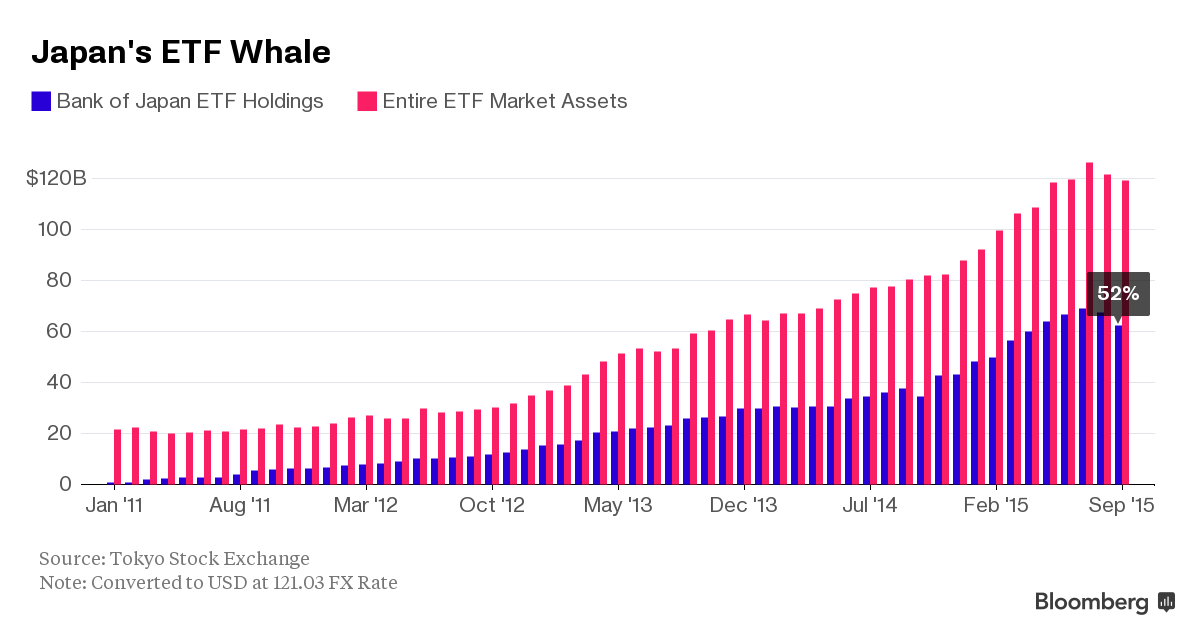
but people shouldn't see this ETF buying as BOJ owning half of Japanese stock market.
why? see: http://www.etf.com/etf-education-center/7540-what-is-the-etf-creationredemption-mechanism.html

with the disappointing stimulus and the market reaction to it, this might have been the best action by the BOJ resulting in a pause of the bond yields collapse and pause in yen strengthening.


http://www.bloomberg.com/news/articles/2015-10-28/owning-half-of-japan-s-etf-market-might-not-be-enough-for-kuroda


Japan’s central bank already owns more than half of the nation’s market for exchange-traded stock funds, and that might just be the start. The Bank of Japan will boost stimulus on Friday, according to 16 of 36 economists in Bloomberg’s latest survey, with 12 saying it would do so by increasing its annual ETF-buying budget. With 3 trillion yen ($25 billion) a year in existing firepower, the BOJ has accumulated an ETF stash that accounted for 52 percent of the entire market at the end of September, figures from Tokyo’s stock exchange show.


http://www.bloomberg.com/news/articles/2016-04-24/the-tokyo-whale-is-quietly-buying-up-huge-stakes-in-japan-inc


They may not realize it yet, but Japan Inc.’s executives are increasingly working for a shareholder unlike any other: the nation’s money-printing central bank. While the Bank of Japan’s name is nowhere to be found in regulatory filings on major stock investors, the monetary authority’s exchange-traded fund purchases have made it a top 10 shareholder in about 90 percent of the Nikkei 225 Stock Average, according to estimates compiled by Bloomberg from public data. It’s now a major owner of more Japanese blue-chips than both BlackRock Inc., the world’s largest money manager, and Vanguard Group, which oversees more than $3 trillion.

They may not realize it yet, but Japan Inc.’s executives are increasingly working for a shareholder unlike any other: the nation’s money-printing central bank. While the Bank of Japan’s name is nowhere to be found in regulatory filings on major stock investors, the monetary authority’s exchange-traded fund purchases have made it a top 10 shareholder in about 90 percent of the Nikkei 225 Stock Average, according to estimates compiled by Bloomberg from public data. It’s now a major owner of more Japanese blue-chips than both BlackRock Inc., the world’s largest money manager, and Vanguard Group, which oversees more than $3 trillion.
The central bank said in December that it plans to buy additional ETFs that weigh holdings based on metrics that include research spending and employee wage growth, but it hasn’t started those purchases yet because the funds don’t exist.

https://next.ft.com/content/4fd7dd18-5523-11e6-befd-2fc0c26b3c60

“The BoJ clearly disappointed the market today with neither an increase in the amount of Japanese government bonds to be bought or a further cut in the policy rate,” said Michael Moen, a portfolio manager at Aberdeen Asset Management in Singapore. 
“The measures announced today to increase ETF purchases and to increase the USD lending programme will not have a material impact on the inflationary outlook,” he said. The BoJ cut its forecast for inflation in the year to March 2017 from 0.5 per cent to 0.1 per cent but kept its forecast for the following year unchanged at 1.7 per cent. The decision to keep policy on hold came after new data showing Japan is still mired in deflation, with prices down 0.4 per cent on a year ago in June.

Saturday, August 6, 2016

Negative yields are a sign of idiocy in desperation and everyday loss of capital in native currency is already in play


http://www.bloomberg.com/view/articles/2016-07-27/maybe-negative-yields-are-a-sign-of-prosperity

Keep in mind that if you buy securities at a yield of negative 1 percent a year, and equities are yielding 4 percent on average, your insurance cost on the safer securities is roughly 5 percent of the upfront investment.  So on $10 trillion of safe securities, that is an insurance premium of roughly $500 billion -- a relatively small chunk of the $300 or $400 trillion of total global wealth.  In percentage terms it is cheaper than the homeowner’s insurance many of us pay for every day. 
firstly,
instead of paying 5% to ensure my money is safe from being invested in equities in the first place, here's a radical thought: don't invest in equities.

secondly,
if your cash currency is dropping at a annualized compounded rate of -5.19% from 1GBP = SGD 3 to presently 1GBP = SGD 1.76 for the past 10 years, and your income growth is not keeping up, here's another thought: haul ass to Singapore/United States.
hint: a lot of europeans are already doing so and the pace picked up recently due to the symptons of stress in the terror attacks. e.g. Nice lorry rolling, Munich mall shootings, Brussels bombing...


Thirdly,
US equities are at all time highs. what are you smoking?
and on the other hand, if you can't take risk (loss of capital), switch your currencies.

Fourthly,
Buy a property and start a business.

Lastly,
on a personal level, you can do any of the above. for institutions, there is always some place you can park your money. don't be lazy.


Thursday, August 4, 2016

Facebook moving into ecommerce

Facebook moving into ecommerce.


http://www.reuters.com/article/us-facebook-emergingmarkets-idUSKCN10E1HT
Facebook Inc is to let small businesses in emerging markets sell to customers for free through their Facebook pages, the social media company said on Wednesday, marking a new effort to build up potential advertisers in its fastest-growing regions.
The move is Facebook's latest foray onto online commerce in emerging markets. The company launched a service last year allowing some merchants to sell items through paid ads on Facebook's app. The latest service will instead be free, and users can view products through merchants' own Facebook pages.

Wednesday, August 3, 2016

Empires in History

http://www.justtheflight.co.uk/blog/35-mapping-the-empires-of-history.html


Crypto currencies and electronic money allow bigger and faster bank heists

the inusability of crypto currencies as money for now.


http://mashable.com/2016/08/03/bitfinex-hacked/#nVD_2p24dmqS

Prominent Bitcoin exchange Bitfinex was hacked Wednesday, leading to a rumoured loss of bitcoin worth up to $65 million.

The Hong Kong company halted trading on its website, where a notice states: "Today we discovered a security breach that requires us to halt all trading on Bitfinex, as well as halt all digital token deposits to and withdrawals from Bitfinex."
looks like a trade setup


Largest heists in Bitcoin:
1) MtGox: 850,000 BTC
2) Silk Road: 171,955 BTC
3) @Bitfinex: 119,756 BTC
4) MyBitcoin: 78,739 BTC

Tuesday, August 2, 2016

Chinese are buying from Japan via apps and amazon japan

amazing, the spillover from chinese demand for hongkong consumer goods seems to be overflowing into japan.

http://www.bloomberg.com/news/articles/2016-08-01/china-s-new-killer-app-a-princess-a-pea-and-a-way-around-japan

The app with the fairy tale name, called Wandou in Chinese, uses about 50 professional shoppers in Japan to procure everything from toilet-seat covers to toothpaste for consumers over in China. For Chen, it’s a way of getting safe and reliable everyday items without having to leave her home or the country, and shipping is free for orders over 300 yuan ($45).
Chinese have been flocking to Japan for electronics, luxury and consumer goods for years, perceiving them to be better and more luxurious than what they can buy at home. Five million Chinese tourists shelled out 1.4 trillion yen ($13.7 billion) there last year, a 154 percent increase from 2014, Japan’s tourism agency says.
Amazon Inc. recently added Chinese language to its Japanese website, lowered the cost of shipping to China and enabled shoppers in China to pay with local currency in response to demand for goods ranging from health and personal care products to cosmetics, Amazon Japan President Jasper Cheung said in a July 27 interview.
Wandou users can make purchases from among more than 3,000 items -- from Lion Corp. toothpaste and Kao Corp. sanitary pad to Calbee Inc.’s potato snacks -- stocked in a 20,000 square-foot warehouse near Tokyo’s Haneda airport. Orders are shipped to China through the company’s own logistics system.
“I want to use made-in-Japan products even if they cost me extra money since I’m scared of Chinese goods,” said Chen. “There are a lot of people like me. Whenever I get good stuff delivered from Japan and introduce them to my friends, they want to buy them right away.”

M&As deal makers for Japan's ageing business owners

amazing. with the ageing population in Japan, maybe the consolidations and M&As will just increase?

http://www.bloomberg.com/news/articles/2016-08-01/the-tinder-for-aging-japanese-ceos-posts-a-1-170-stock-gain

Enter Nihon M&A Center Inc., a rare deal-advisory boutique in Japan, which introduced Takeuchi to a young company president on the other side of the country who wanted a foothold in the Tokyo software market. Months later, Takeuchi sold. It was just one of 110 deals Nihon M&A facilitated that year, a number that’s been increasing since it went public in 2006. Helping small-business owners find successors has sent its shares up almost 13-fold since listing.

Sunday, July 31, 2016

Soros: General Theory of Reflexivity


 https://next.ft.com/content/0ca06172-bfe9-11de-aed2-00144feab49a#axzz4AQ9nyngv
Reflexive feedback loops have not been rigorously analyzed and when I originally encountered them and tried to analyze them, I ran into various complications. The feedback loop is supposed to be a two-way connection between the participant’s views and the actual course of events. But what about a two-way connection between the participants’ views? And what about a solitary individual asking himself who he is and what he stands for and changing his behavior as a result of his reflections? In trying to resolve these difficulties I got so lost among the categories I created that one morning I couldn’t understand what I had written the night before. That’s when I gave up philosophy and devoted my efforts to making money.
To avoid that trap let me propose the following terminology. Let us distinguish between the objective and subjective aspects of reality. Thinking constitutes the subjective aspect, events the objective aspect. In other words, the subjective aspect covers what takes place in the minds of the participants, the objective aspect denotes what takes place in external reality. There is only one external reality but many different subjective views. Reflexivity can then connect any two or more aspects of reality, setting up two-way feedback loops between them. Exceptionally it may even occur with a single aspect of reality, as in the case of a solitary individual reflecting on his own identity. This may be described as “self-reflexivity.” We may then distinguish between two broad categories: reflexive relationships which connect the subjective aspects and reflexive events which involve the objective aspect. Marriage is a reflexive relationship; the Crash of 2008 was a reflexive event. When reality has no subjective aspect, there can be no reflexivity.
* * *
Feedback loops can be either negative or positive. Negative feedback brings the participants’ views and the actual situation closer together; positive feedback drives them further apart. In other words, a negative feedback process is self-correcting. It can go on forever and if there are no significant changes in external reality, it may eventually lead to an equilibrium where the participants’ views come to correspond to the actual state of affairs. That is what is supposed to happen in financial markets. So equilibrium, which is the central case in economics, turns out to be an extreme case of negative feedback, a limiting case in my conceptual framework.
By contrast, a positive feedback process is self-reinforcing. It cannot go on forever because eventually the participants’ views would become so far removed from objective reality that the participants would have to recognize them as unrealistic. Nor can the iterative process occur without any change in the actual state of affairs, because it is in the nature of positive feedback that it reinforces whatever tendency prevails in the real world. Instead of equilibrium, we are faced with a dynamic disequilibrium or what may be described as far-from-equilibrium conditions. Usually in far-from-equilibrium situations the divergence between perceptions and reality leads to a climax which sets in motion a positive feedback process in the opposite direction. Such initially self-reinforcing but eventually self-defeating boom-bust processes or bubbles are characteristic of financial markets, but they can also be found in other spheres. There, I call them fertile fallacies—interpretations of reality that are distorted, yet produce results which reinforce the distortion.

comments on smol Equities and Bonds can't be both right. Right?


long duration fixed income investors moving to short term to lower their risk in recent times. you can't change the spots on leopards, fixed income investors will always prefer fixed income. and then there's the positioning by funds too. when even the old and new bond kings go bearish on longer duration bonds, you know there is just one last attempt to hit the highs.
if you are confused by the above paragraph, I have posted some hastily written articles. or you can just google for the info.
some nice stuff there smol.
"With 30 year bonds yielding so low, in the days of old, short term treasuries will be yielding much higher to give an inverted yield curve."


abe and kuroda playing pingpong. neither wants to be responsible.
seriously, time is running out for these deflationary markets.
time to bring on the fiscal spending bazooka.
else it's not just changes in the monetary policy environments,
it's the change in public political sentiments!
"Let's see whether Japan got the guts to be the first country to experiment with "helicopter money" this week."


half the bonds out there in the DM world are negative yielding.
"11 trillions of sovereign bonds globally are now in negative yield. Who owns these bonds? "


nice. correlations work.... until they don't. a nice example is the recent decoupling between oil and us equities.
"Corelation between asset classes change all the time. During GFC, asset classes that have low co-relation become highly co-related. I think not all bonds are created equal."


devaluation of renminbi. right now, it's businesses and asset plays, not just properties.
"You think why rich mainland Chinese are bidding up properties in Canada, Australia, HK, and Singapore?"


how soon? no idea. is there coordination between CBs? no idea.
"Now, when the music stop and central bank start to drain the water back, which glasses will be emptied first and which glass will not be completely emptied?"


haha. a standard idea sold to people who don't know what to do.
"All these years, I've been told to hold both bonds and equities to take advantage when either asset class drops."


nope. SGD is extremely teng (tough to chew) at the moment still. but other currencies are dropping.
"But what am I suppose to do now when both are rising? Both are rising due to increase liquidity cause by QE right? Does this mean that the value of my cash holdings will fall due to inflation?"


is that a leading question? lol
" In that case, am I suppose to buy some precious metal to protect the value?"


what do you think of that, TI?
" Or will it be better to get some ETF to ride on the liquidity wave? Wouldn't this QE bubble burst anytime? It's doesn't make sense to keep printing when it's not back by any assets except our confidence in the paper right?"


that's your reaction? so funny lol and no, i am not making fun of you.
"Why are there so much considerations? Not passive at all leh! 我被骗了"


i imagine it is tough. the risk is so high.
"I tell you, it cannot be fun to be money managers working for pension funds or insurance companies right now.How to secure the "promised" income for your pensioners and policy holders when 10 year US treasury is yielding below 2%???"


somemore still got people recommending crowd funding leh. I see the 13.5% yield on Epicentre for $1m and I go huh? why the management of Epicentre do this? do they need it? what's their vested stake? somemore got so many promoters woh. what are they earning?
"3) Small time newbie "ah longs" losing their money in peer-to-peer lending..."


they go by tranches. the ones where yields are guaranteed means they already bought them. and if the prices go up, they sell to lock in the promised yields and get some float. It's really the mark to market ones that are scary.
by my reckoning, some 'accredited investors' are going to get some real accreditations.
"If it's institutions then quite cham, can't worm their way out of the "promised guaranteed plus chop capital protected with variable bonus interest else my banking hall let you burn" investment that they have sold to their clients, without fearing that these investments will go up in smoke IF the party ends (honestly I think few really knows which direction the market will trend now right?)."


so long ago. such a dangerous time then.
"In the past, where need to invest. Just save put in the bank double digit interest compound. Where got all the rubbish of 5-6% return portfolio per year that we are all shouting now from our portfolio. "


they charge, bank run, lower reserve, unlawful. so they also forced to find yield. else unprofitable, bank selloff. see european banks. it's fun so far.
"Then now negative interest which is the central bank preventing commercial bank to hold money but instead lend it all out. Bank will never charge consumer negative interest. "


I always maintained bonds have the same risk as stocks.
risk is defined as permanent loss of capital.
the volatility is different, that's all.
"" Don’t forget that bond prices crashed in late 2008, and many stopped paying dividends."


lol are you positioned?
"In investing, its all about positioning - before the event happens."


don't like that. lol
they doing their best already.
I don't know about their market knowledge of all these current batch.
(LHL and tharman are really smart people though.)
but they did put in their heart. even upped the CPF RA rates via a tiered system.
I just hope they are not eating into reserves again. (I am a miser.)
and not squeezing juice out of the GIC rock.
forcing people an impossible target sometimes result in disasterous consequences.
"Those of us who worked in corporate and experienced a top management change would appreciate.Promises made by the previous management to you become words written on water :("


nice.
"Just look at ASEAN - how many are run by the military in the background? So far so good? That's because we have a BIG STICK!"


gan en
"If I look at Taiwan and HK for the past 10 years; and Japan for the past 30 years... I am just grateful how life has turned out for me and my family."


Iran produces oil India consumes oil

http://www.bloomberg.com/news/articles/2016-07-28/biggest-oil-market-embraces-iran-once-again-as-asia-imports-jump

At the biggest oil market in the world, crude from Iran is back in vogue.
The Persian Gulf state boosted exports to major oil consumers in Asia during the first half of this year, after international sanctions that restricted its supplies were eased in January. Japan’s purchases increased 28 percent, India bought 63 percent more, South Korea’s imports more than doubled while shipments into China gained 2.5 percent during the six months, government and shipping data compiled by Bloomberg show.
The increase in cargoes to Asia shows Iran is having some success in meeting its pledge to prioritize regaining market share it lost in the region due to the sanctions over its nuclear program. The nation, which was OPEC’s second-biggest producer before the international measure choked off its supplies, defied skeptics with a 25 percent surge in production so far in 2016 and aims to reach an eight-year high for daily output of 4 million barrels by the end of the year.
India, forecast by the IEA to be the second-biggest oil consumer, boosted purchases from Iran to about 338,000 barrels a day during January to June from almost 207,000 barrels in the same period a year earlier, according to shipping data obtained by Bloomberg. Shipments to South Korea, the fourth-largest user in the region, jumped 123 percent to about 265,000 barrels a day, data from Korea National Oil Corp. show. Top Asian consumer China bought 603,000 barrels daily. 

Friday, July 29, 2016

IMF independent evaluation Office says IMF kelong?

http://www.telegraph.co.uk/business/2016/07/28/imf-admits-disastrous-love-affair-with-euro-apologises-for-the-i/

time for AIIB?
The report by the IMF’s Independent Evaluation Office (IEO) goes above the head of the managing director, Christine Lagarde. It answers solely to the board of executive directors, and those from Asia and Latin America are clearly incensed at the way EU insiders used the Fund to rescue their own rich currency union and banking system. 
The three main bail-outs for Greece, Portugal, and Ireland were unprecedented in scale and character. The trio were each allowed to borrow over 2,000 percent of their allocated quota – more than three times the normal limit – and accounted for 80pc of all lending by the Fund between 2011 and 2014. 
The report said the whole approach to the eurozone was characterised by “groupthink” and intellectual capture. They had no fall-back plans on how to tackle a systemic crisis in the eurozone – or how to deal with the politics of a multinational currency union – because they had ruled out any possibility that it could happen. 
“Before the launch of the euro, the IMF’s public statements tended to emphasize the advantages of the common currency, “ it said. Some staff members warned that the design of the euro was fundamentally flawed but they were overruled.