
Showing posts with label currencies. Show all posts
Showing posts with label currencies. Show all posts
Monday, September 19, 2016
Friday, August 19, 2016
Mongolia hikes interest to 15%
The central bank of Mongolia raised its key interest rate to 15 percent to protect the currency, reversing a cut in borrowing costs to 10.5 percent in May.
The Mongolian tugrik initially rose after the announcement. By 4:26 p.m. in Ulaanbaatar it was falling again, and traded at 2,268 per dollar. The currency is headed for its 24th straight daily decline.

Friday, August 12, 2016

Ruble a top performing currency among increasingly higher valued EM currencies
keeping an eye
http://www.bloomberg.com/news/articles/2016-08-11/to-see-where-world-s-easy-money-is-going-look-at-russia-s-ruble

The future’s looking brighter, too, with options traders the least pessimistic on the ruble’s long-term prospects since mid-2014.
Years of easy-money policies in developed economies have pushed yields below zero from Japan to Europe -- in stark contrast to Russia, whose 10.5 percent main rate makes it a popular destination for money borrowed cheaply elsewhere.
“The ruble is going to be one of the outperformers in the emerging markets,” said Saad Siddiqui, an analyst at JPMorgan Chase & Co., which topped Bloomberg’s latest currency rankings for Europe, the Middle East and Africa. “It offers one of the best carry trades.”
JPMorgan is predicting a 5 percent gain in the ruble to 61.36 per dollar by year-end, from 64.72 in Moscow on Friday. That contrasts with the 1 percent drop forecast in a Bloomberg survey of analysts.
The Yuan Anniversary that Really Matters Is 2005, Not 2015 and Yuan joining the basket on Oct 1
keeping an eye.
http://www.bloomberg.com/news/articles/2016-08-12/the-yuan-anniversary-that-really-matters-it-s-2005-not-2015

http://www.bloomberg.com/news/articles/2016-08-12/the-yuan-anniversary-that-really-matters-it-s-2005-not-2015

Back in July of 2005, China’s central bank broke a decade-long peg to the dollar. It’s an anniversary that attracted far less attention, but the move 11 years ago helped set the stage for China’s emergence as an economic superpower.
Authorities pegged the currency back in the mid 1990s to stoke exports and economic growth, shortly after abandoning a dual exchange-rate system for imports and exports. Governments in the U.S. and Europe criticized China for running up a huge trade balance by keeping its currency artificially undervalued in their view.
"In 2005, we were in a global supercycle, helped by an unsustainable credit boom in the west and China’s industrialisation and urbanization," Mann said. "In the last few years we have been seeing policy makers coming to terms with sluggish growth in the post credit boom west and east. China is easily the most dominant driver of global growth, accounting for a third of world growth even as it slows and transitions towards services and consumption."
The yuan is set to join the International Monetary Fund’s elite basket of reserve currencies on Oct. 1. That entry could attract as much as $1 trillion of buying by global reserves managers. China also has opened a network of yuan clearing-banks around the world.
But for all the hype, the yuan remains some distance from being viewed as a global reserve asset in the way that the dollar or euro is. While authorities preach liberalization, at the same time they have enforced strict rules on moving money out of the country after a record exodus in 2015. And some analysts still fear a steepdevaluation.
For now, the lesson from 2005 is that shock currency events are ultimately just growing pains for a rapidly changing economy. With the passing of time, 2015 can be viewed in the same way, Bloomberg Intelligence economists Fielding Chen and Tom Orlik wrote in a note.
"A year on, the PBOC’s surprise move is looking less like a disastrous misstep, and more like a necessary evil on the path to a more flexible exchange rate regime," they wrote.
"Significant progress has been made."

Monday, August 8, 2016
Crypto currencies not yet ready, hacking to be solved first
spreading the loss among customers when it was the fault of the company.
there you go.
crypto-currency without true regulation and no watchdog.
and you thought it would replace international currencies?
anything without government recognition is not a currency because they can be legislated away by the governments, cheated from people without compensation/recourse, and the fall can be very rapid.
GBP fell 10% this one went 36% and can go to zero by just the announcement of a crypto-currency supported by governments.
related:
http://shiohmekiah.blogspot.com/2016/08/crypto-currencies-and-electronic-money.html
http://www.bloomberg.com/news/articles/2016-08-07/hacked-bitcoin-exchange-users-to-lose-36-will-receive-tokens
there you go.
crypto-currency without true regulation and no watchdog.
and you thought it would replace international currencies?
anything without government recognition is not a currency because they can be legislated away by the governments, cheated from people without compensation/recourse, and the fall can be very rapid.
GBP fell 10% this one went 36% and can go to zero by just the announcement of a crypto-currency supported by governments.
related:
http://shiohmekiah.blogspot.com/2016/08/crypto-currencies-and-electronic-money.html
http://www.bloomberg.com/news/articles/2016-08-07/hacked-bitcoin-exchange-users-to-lose-36-will-receive-tokens
Hong Kong-based Bitfinex said all users will lose 36 percent of their deposits after the bitcoin exchange concluded its review of a $71 million hacking attack.To compensate its customers, Bitfinex said users will receive tokens that may later be redeemed or exchanged for shares in its parent company. Following the announcement, bitcoin climbed to $594 as of 10:55 a.m. on Sunday in Tokyo, based on prices from Coinbase. The virtual currency dropped 12 percent to $577.23 in the week through Friday, its largest weekly decline since June, according to Bloomberg prices.
Sunday, August 7, 2016
BOJ buying up Japanese ETFs and creating new shares but only maintained bond buying
BOJ buying up Japanese ETFs and creating new shares.
but they did not increase the bond buying.
but people shouldn't see this ETF buying as BOJ owning half of Japanese stock market.
why? see: http://www.etf.com/etf-education-center/7540-what-is-the-etf-creationredemption-mechanism.html
with the disappointing stimulus and the market reaction to it, this might have been the best action by the BOJ resulting in a pause of the bond yields collapse and pause in yen strengthening.
http://www.bloomberg.com/news/articles/2015-10-28/owning-half-of-japan-s-etf-market-might-not-be-enough-for-kuroda

http://www.bloomberg.com/news/articles/2016-04-24/the-tokyo-whale-is-quietly-buying-up-huge-stakes-in-japan-inc

https://next.ft.com/content/4fd7dd18-5523-11e6-befd-2fc0c26b3c60
but they did not increase the bond buying.
but people shouldn't see this ETF buying as BOJ owning half of Japanese stock market.
why? see: http://www.etf.com/etf-education-center/7540-what-is-the-etf-creationredemption-mechanism.html
with the disappointing stimulus and the market reaction to it, this might have been the best action by the BOJ resulting in a pause of the bond yields collapse and pause in yen strengthening.
http://www.bloomberg.com/news/articles/2015-10-28/owning-half-of-japan-s-etf-market-might-not-be-enough-for-kuroda
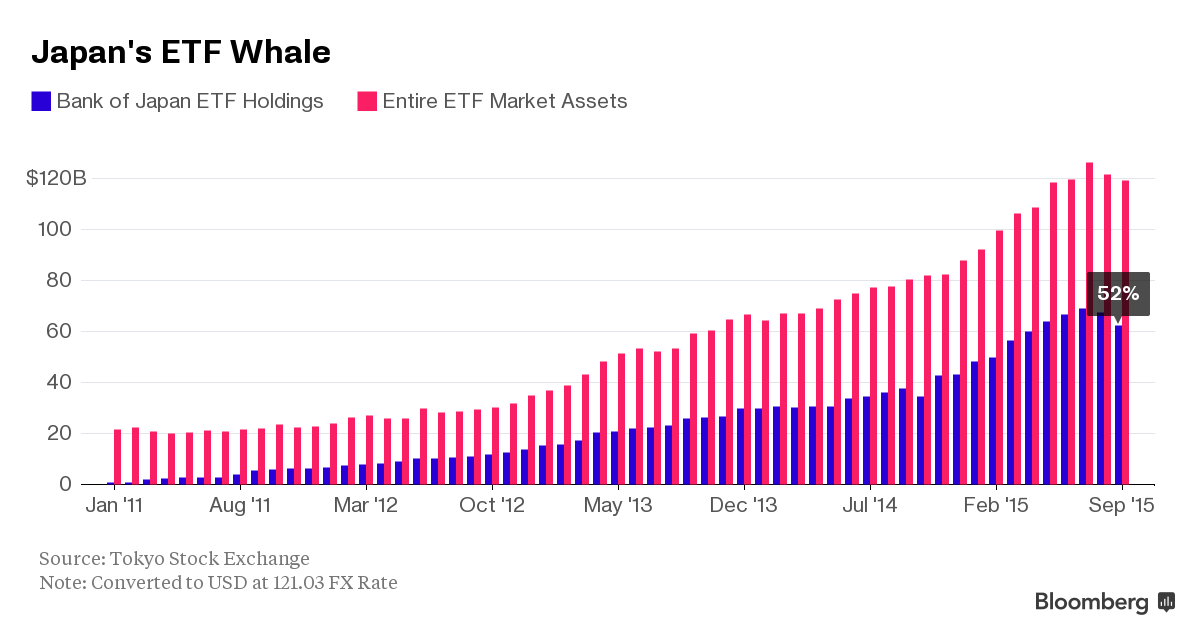
Japan’s central bank already owns more than half of the nation’s market for exchange-traded stock funds, and that might just be the start. The Bank of Japan will boost stimulus on Friday, according to 16 of 36 economists in Bloomberg’s latest survey, with 12 saying it would do so by increasing its annual ETF-buying budget. With 3 trillion yen ($25 billion) a year in existing firepower, the BOJ has accumulated an ETF stash that accounted for 52 percent of the entire market at the end of September, figures from Tokyo’s stock exchange show.
http://www.bloomberg.com/news/articles/2016-04-24/the-tokyo-whale-is-quietly-buying-up-huge-stakes-in-japan-inc

They may not realize it yet, but Japan Inc.’s executives are increasingly working for a shareholder unlike any other: the nation’s money-printing central bank. While the Bank of Japan’s name is nowhere to be found in regulatory filings on major stock investors, the monetary authority’s exchange-traded fund purchases have made it a top 10 shareholder in about 90 percent of the Nikkei 225 Stock Average, according to estimates compiled by Bloomberg from public data. It’s now a major owner of more Japanese blue-chips than both BlackRock Inc., the world’s largest money manager, and Vanguard Group, which oversees more than $3 trillion.
They may not realize it yet, but Japan Inc.’s executives are increasingly working for a shareholder unlike any other: the nation’s money-printing central bank. While the Bank of Japan’s name is nowhere to be found in regulatory filings on major stock investors, the monetary authority’s exchange-traded fund purchases have made it a top 10 shareholder in about 90 percent of the Nikkei 225 Stock Average, according to estimates compiled by Bloomberg from public data. It’s now a major owner of more Japanese blue-chips than both BlackRock Inc., the world’s largest money manager, and Vanguard Group, which oversees more than $3 trillion.
The central bank said in December that it plans to buy additional ETFs that weigh holdings based on metrics that include research spending and employee wage growth, but it hasn’t started those purchases yet because the funds don’t exist.
https://next.ft.com/content/4fd7dd18-5523-11e6-befd-2fc0c26b3c60
“The BoJ clearly disappointed the market today with neither an increase in the amount of Japanese government bonds to be bought or a further cut in the policy rate,” said Michael Moen, a portfolio manager at Aberdeen Asset Management in Singapore.
“The measures announced today to increase ETF purchases and to increase the USD lending programme will not have a material impact on the inflationary outlook,” he said. The BoJ cut its forecast for inflation in the year to March 2017 from 0.5 per cent to 0.1 per cent but kept its forecast for the following year unchanged at 1.7 per cent. The decision to keep policy on hold came after new data showing Japan is still mired in deflation, with prices down 0.4 per cent on a year ago in June.
Saturday, August 6, 2016
Negative yields are a sign of idiocy in desperation and everyday loss of capital in native currency is already in play
http://www.bloomberg.com/view/articles/2016-07-27/maybe-negative-yields-are-a-sign-of-prosperity
Keep in mind that if you buy securities at a yield of negative 1 percent a year, and equities are yielding 4 percent on average, your insurance cost on the safer securities is roughly 5 percent of the upfront investment. So on $10 trillion of safe securities, that is an insurance premium of roughly $500 billion -- a relatively small chunk of the $300 or $400 trillion of total global wealth. In percentage terms it is cheaper than the homeowner’s insurance many of us pay for every day.firstly,
instead of paying 5% to ensure my money is safe from being invested in equities in the first place, here's a radical thought: don't invest in equities.
secondly,
if your cash currency is dropping at a annualized compounded rate of -5.19% from 1GBP = SGD 3 to presently 1GBP = SGD 1.76 for the past 10 years, and your income growth is not keeping up, here's another thought: haul ass to Singapore/United States.
hint: a lot of europeans are already doing so and the pace picked up recently due to the symptons of stress in the terror attacks. e.g. Nice lorry rolling, Munich mall shootings, Brussels bombing...

Thirdly,
US equities are at all time highs. what are you smoking?
and on the other hand, if you can't take risk (loss of capital), switch your currencies.
Fourthly,
Buy a property and start a business.
Lastly,
on a personal level, you can do any of the above. for institutions, there is always some place you can park your money. don't be lazy.
Wednesday, August 3, 2016
Crypto currencies and electronic money allow bigger and faster bank heists
the inusability of crypto currencies as money for now.

http://mashable.com/2016/08/03/bitfinex-hacked/#nVD_2p24dmqS

Largest heists in Bitcoin:
1) MtGox: 850,000 BTC
2) Silk Road: 171,955 BTC
3) @Bitfinex: 119,756 BTC
4) MyBitcoin: 78,739 BTC

Prominent Bitcoin exchange Bitfinex was hacked Wednesday, leading to a rumoured loss of bitcoin worth up to $65 million.
The Hong Kong company halted trading on its website, where a notice states: "Today we discovered a security breach that requires us to halt all trading on Bitfinex, as well as halt all digital token deposits to and withdrawals from Bitfinex."

looks like a trade setup
Largest heists in Bitcoin:
1) MtGox: 850,000 BTC
2) Silk Road: 171,955 BTC
3) @Bitfinex: 119,756 BTC
4) MyBitcoin: 78,739 BTC
Sunday, July 10, 2016
Markets: are we there yet? - 2016
Recently, it looks as though we are coming to a crucial point in the markets.
Both US Stocks (S&P 500) and Bonds (global government bonds) are at All Time Highs.
Normally, when you are worried, you divests your stocks into bonds, so risk off.
when you are greedy, you sell your bonds and buy more stocks, so risk on.
However, developed markets government bonds yields are at all time low while US stocks are at all time highs. This is compounded by the persistent devaluation of developed markets currencies (less Japan) by the actions of central banks. On the other hand, you have all time lows in commodities with agricultural lows, energy coming off an all time low and gold and silver seemingly resuming their climb from more than a decade ago after the recent 4-5 years bear.
Summing up, we know that generally that
for bonds,
- when bond yields go down, bond prices goes up
- when interest rates go up, bond yields go up and bond prices go down
- in 1998, 10 yr singapore govt bond yield can be 5.69%
- negative yields can result in capital losses
- bond cycles are seemingly reaching the end of the decreasing yield cycle
- half of the developed world govt bond yields are negative
for currencies,
- most european currencies and CNY are dropping vs USD while yen is increasing
- some emerging markets currencies are gaining vs USD (some are commodity producers)
- reallocation of currencies from fiat to gold and silver
for stocks,
- yields are now in stocks? (there's renewed buying in the top yields markets, from income funds?)
- sector rotation in US equities from financials to real estate.
- US S&P 500 just broke out to all time highs (notice the divergence from emerging markets)
Note of caution: in trending markets, they can trend for a long long time.

Where are the currencies going?
for acronyms, you can refer to currencies of the world.

CNY is dropping in value vs USD again.
some currencies vs USD


Tuesday, July 5, 2016
Gold a most winning investment in 2016 so far

More than 100% year to date.
The more widely accepted currency (crypto doesn't count) other than Japanese Yen that is least subjected to central bank manipulations and negative interest rates.
I treated it as a speculative asset bubble and maybe that is a correction I should make.
"Some regard it as a metal, we regard it as a currency and it remains our largest currency allocation."
- Druckenmiller

Japanese Yen - poor chaps just can't do anything to lower it!
Wednesday, May 11, 2016

Subscribe to:
Posts (Atom)